Ideas · International Brands

What Does an Exhibition Fabrication Partner Do for International Brands?

Ideas · International Brands

Overview

For an international brand exhibiting in India, a fabrication partner isn't just a vendor — it's a shadow. Someone who moves with you through every step, seen and unseen.

We're not just the people who hand you a 3D layout, design your stall, and arrange labour to bring it to life. We're your eyes on the ground — walking the venue when you can't, navigating the formalities, and standing in on the financial negotiations that matter. We bring the local connect that only comes from years in the city: negotiated rates on labour, vendors, machinery, and porters, and the marketing outreach that turns visibility into results. We handle your travel, your food and beverage — every detail that isn't glamorous but is exactly what makes a show run without a hitch.

In short, we're your one-stop destination — the partner who shows up before you land, and stays until after you leave.

What Are Good Annual Day Themes?

What Is Included in the Role?

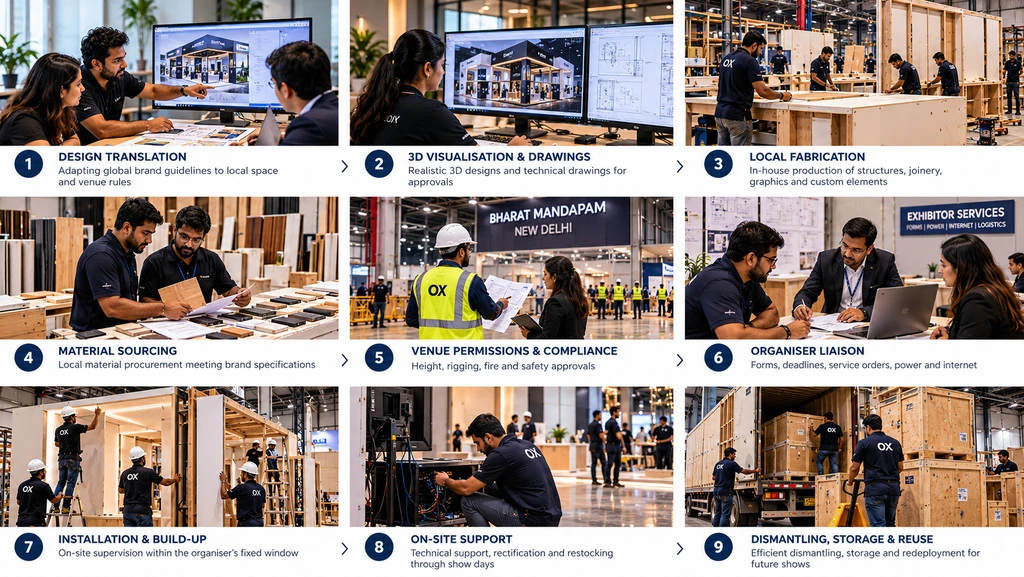
The scope is wider than fabrication alone. For overseas exhibitors it spans design translation, compliance, procurement, build and on-ground representation — the functions an in-market team would otherwise have to perform.

  • Design translation — adapting global stand guidelines to the booked space, local materials and venue rules
  • 3D visualisation and drawings — so approvals happen on screen before anything is cut
  • Local fabrication — structures, joinery, graphics and custom elements built in-country
  • Material sourcing — finding local equivalents that meet brand specification
  • Venue permissions and compliance — height, rigging, fire and safety approvals
  • Organiser liaison — forms, deadlines, service orders, power and internet
  • Installation and build-up supervision — within the organiser's fixed window
  • On-site support through show days — rectification, restocking, technical issues
  • Dismantling, storage and reuse — for brands returning to the same market
How Does the Working Relationship Run Across Time Zones?

Distance shouldn't mean delay — and a time difference shouldn't mean waiting till morning for an answer. Here's how we make it work, step by step:

  • A single point of contact. From day one, you're assigned one dedicated coordinator who manages the entire project — so you're never chasing different people for different answers, no matter the hour.
  • Overlap hours, set upfront. We identify a working window that overlaps with your time zone — even if it means our team logs in early or stays back late — so calls and approvals happen live, not through delayed emails.
  • Everything shared digitally, in real time. 3D designs, material samples, and layout changes are sent through shared drives and messaging channels the moment they're ready, with written confirmations for every approval — so nothing depends on a single call being caught live.
How Does the Working Relationship Run Across Time Zones?
  • Async updates fill the gaps. For anything outside overlap hours, we send structured updates — design notes, photos, and progress summaries — so when you wake up, you already know exactly where things stand.
  • On-ground reporting during build-up. As show days approach, updates shift to real-time site photos and short videos of the build in progress, so you can see your stall taking shape without being physically present.
  • Final walkthrough before you land. By the time you arrive in India, a full walkthrough — virtual or recorded — is done, so there are no surprises. You walk onto a floor you've already seen, approved, and trust.

The goal through every step is simple: you should never feel far from your own stall, no matter which time zone you're working from

What Should You Know About Indian Exhibition Venues?

Every venue in India has its own personality — and if it's your first show here, that personality can catch you off guard.

What Should You Know About Indian Exhibition Venues?

Exhibitions don't just happen at convention grounds. They also run out of hotel banquet halls and German hangers — temporary, tent-like structures used when a permanent venue isn't the right fit.

Here's what matters most:

  • Infrastructure varies by venue type. — Convention grounds like Pragati Maidan, Bharat Mandapam, Yashobhoomi, Bombay Exhibition Centre, and HITEX Hyderabad each have strict power and structural limits. Hotel ballrooms bring chandeliers, low ceilings, and tighter aesthetic rules. German hangers offer more design freedom but need reinforced anchoring and their own approach to flooring and lighting.
  • Power and rigging are negotiated, not guaranteed. — Load approvals and rigging permissions differ by venue — and need to be planned weeks in advance, not discovered on-site.
  • Move-in and move-out windows are strict. — Every venue runs on a tight shared schedule. Missing your slot can mean penalties or a shorter build window.
  • Local permissions take time. — Fire safety clearances and structural certifications are mandatory, and hotel properties often add their own approval layers.
  • Not all venues allow the same materials. — Fire-safety norms shift by venue, especially indoors — what worked at one show may need modification at the next.

This is where Occasion Xperts steps in.

A set of reusable frames and panels that gets rented, reassembled, and reconfigured for each new event.We were part of launching Yashobhoomi, built extensively at Bharat Mandapam, worked within Jio World Convention Centre, and hold hotel partnerships built over years. For German hangers, we go further — designing not just the booth, but the entire trade fair layout within the structure.

Whatever the venue, we already know the room before you walk into it.

What Should You Ask Before Appointing?

Ten questions separate a fabricator who can build a stand from a partner who can represent you in-market.

  • Which international brands have you built for, Could you share us the P.O of your previous clients
  • Have you built in this specific venue in the last two years?
  • Is fabrication in-house or subcontracted — and can we see the workshop?
  • Who is our single point of contact, and what is their relevant experience in this field?
  • What does your timeline look like for the various phases, and what is your timeline management strategy?
  • How do you source material equivalents to our brand specification?
  • What exactly do you handle on customs, freight and venue service orders — and what don't you?
  • Who is on site during build-up and show days, and are they the people on this call?
  • How is the cost sheet itemised, and what triggers a variation?
  • Can elements be stored and reused for our next Indian show?
What Should You Ask Before <em>Appointing?

Frequently Asked Questions

What does an exhibition fabrication partner do?

A fabrication partner designs and physically builds your exhibition stand, then installs it, supports it through the show and dismantles it. For an overseas brand it usually also means acting as your local agent: handling organiser paperwork, venue permissions, material sourcing and on-ground problem-solving in the weeks you cannot be in the country.

Should an international brand ship a stand to India or build locally?

Building locally is usually faster and cheaper once import duty, freight, customs clearance and the risk of delayed release are counted. Shipping makes sense for specialised display elements, precision product fixtures or components that must match global brand standards exactly — a hybrid approach, shipping a few elements and fabricating the rest locally, is common.

How do design approvals work across time zones?

Through a fixed approval calendar agreed at the start, with 3D visuals and drawings issued at set milestones and a standing weekly call. The practical rule is that every approval deadline should be set in your time zone, not the fabricator's, with a named decision-maker on each side.

What should international brands know about Indian exhibition venues?

Build-up windows, height and rigging limits, material and fire regulations, power provisioning and marshalling procedures differ significantly between halls at Bharat Mandapam, Pragati Maidan, Yashobhoomi and India Expo Mart. Requirements are venue-specific rather than national, which is why local venue familiarity matters more than general fabrication capability.

Who handles customs if we ship products for display?

Product shipments for display are usually handled through the show's official freight forwarder or an ATA Carnet, depending on whether goods are re-exported. Your fabrication partner coordinates delivery to the stand and storage, but customs clearance itself is normally a specialist freight function — agree to the split of responsibility in writing before shipping.

How far in advance should an overseas exhibitor appoint a partner in India?

Eight to twelve weeks before the show for a custom build. Overseas exhibitors need more lead time than domestic ones because approvals cross time zones, artwork often needs adaptation, and any shipped elements need a customs buffer.

Planning an event